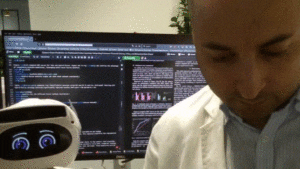
Dr. David Hason Rudd Ph.D.
Member of EA, IEA, IEEE, and ACM
Short Bio
Dr David Hason Rudd is a seasoned academic and industry professional, currently serving as a sessional lecturer at the School of Computer Science within the Faculty of Engineering and IT (FEIT), UTS Business School, and the Faculty of Arts and Social Sciences (FASS) at the University of Technology Sydney (UTS). He also holds a full-time position as Program Coordinator, Senior Lecturer and Data Analytics Lead at the Australian Institute of Higher Education (AIH). Dr Rudd earned both his PhD in Analytics (C02029) and Master of Science (Research) in Computing Science (C03025) from UTS, with his research spanning machine learning, smart sensing, and applied data science. His interdisciplinary and transdisciplinary academic roles reflect a deep commitment to preparing the next generation of professionals across computing, business, and social contexts.
His research portfolio is broad and impactful, encompassing areas such as causal machine learning, Industry 4.0 technologies, 5G networks and smart sensing. A significant focus of his work is on the innovative application of signal processing and deep learning to recognise emotional and mental states from speech data, providing insights into human behaviour and interaction. Moreover, his research focuses on advancing financial analytics and has developed a method called “Financial X-Ray”. This innovative approach combines semi-supervised and deep learning techniques to predict customer financial literacy.
Additionally, his expertise extends to conducting causal analysis of customer churn, which aids financial institutions in understanding the cause of attrition.
He actively collaborates with the Data Science & Machine Intelligence Lab (DSMI.tech) on industrial research projects. His work includes a study on customer churn for the Australian Dental Association, identifying key factors in member retention. He also developed drone-assisted AI-IoT techniques to enhance 5G indoor coverage predictions in 3D models. His dedication to the advancement of data science is reflected in his prolific contributions to esteemed journals and major conferences, making him a prominent figure in his field. He has published several papers in prestigious venues, including IEEE-sponsored conferences such as PAKDD, DSInS, AJCAI, BESC, KES, etc.
In the industrial section, he is a qualified professional engineer, holding credentials from Engineers Australia (MID #8385590) and Industrial Engineers Australia (MID #4473294), along with a license as a registered Design Building Practitioner (DBP) class 3 in electrical design (License #0-10-530-01580). He has over 17 years of multidisciplinary engineering experience, spanning four countries and fields including electrical, telecommunications, engineering management, and data analytics. This broad experience enables him to connect with students from diverse academic backgrounds effectively, providing tailored guidance. David teaches a range of large undergraduate and postgraduate subjects in predictive and prescriptive business analytics, information systems, application implementation, and machine learning for data mining.
Academic Qualifications
- Doctor of Philosophy (PhD) PhD, Analytics (C02029), School of Computer Science, University of Technology Sydney, Sydney, Australia
- Research Area: Data Analytics
- Thesis: Investigating Organisational Member Engagement Through Financial X-ray & Neural Networks
- Master of Science (Research), Computing Science (C03025), School of Computer Science, University of Technology Sydney, Sydney, Australia
- Research Area: Data Analytics
- Thesis: Predicting Financial Literacy via Deep Learning
- Bachelor of Science in Electrical Engineering, IAUSTB
- Research Area: Robotics and Automation
- Thesis: Integrating Modern Security Protocols with Z80-Based Access Control Systems.
Teaching, Supervision & Subject Coordinator (SC)
- 42050: SAS Predictive Business Analytics (SC)
- 26777: Data Processing Using SAS
- 41181: Information Security and Management
- 41030: Engineering Capstone Supervisor
- 41029: Engineering Research Preparation
- 41004: AI/Analytics Capstone Project
- 570002: Application Implementation with Microsoft Dynamics
- 24761: Data Driven Insights
- BISY2006: Management Information System and Enterprise System (SC)
- BISY1001: Professional and Ethical Practice (SC)
- BISY2007: Systems Design Thinking
- BISY3001: Data Mining and Business Intelligence (SC)
- BISY2007: E Commerce and E Business Application
- MBIS5012: Strategic Information Systems
- MBIS5011: Enterprise System
- MBIS5018: Business Analytics and Intelligence
- MBIS5013: Sustainability and Enterprise 4.0
- MBIS4002: Database Management Systems
- MBIS4016: Discovering Data Analytics
- MBIS5009: Business Analytics
- MBIS4007: Big Data and Visualisation
- MBIS5020: Project Management
- MBIS5017: Artificial Intelligence Fundamentals
- MBIS5008: Cloud and Big Data for Data Analytics
- MBIS5007: Penetration Testing and Cloud Security
Industrial Research Experiences
- Research in Advanced RF Sensing using AIoT Drone and Edge Computing to Improve IBC Optimisation.
- Research in Member Engagement project at the Australian Dental Association.
Academic Experiences
- Academic Program Coordinator
- Subject Coordinator at UTS & AIH
- Senior Lecturer at AIH
- CA Lecturer in data analytics at FEIT/UTS
- Sessional Lecturer and Tutor, School of Computer Science, UTS
Industrial Experiences
- NBN Fibre Design Admin (Telstra Project)
- Project Data Analyst (Lendlease Project)
- RAN & Optimisation Engineer (NOKIA Project)
- Registered Building Practitioner (Medium Rise-Class 2)
Professional Activities
Journal and Conference Reviewer (Regular):
- Internet of Things Journal (IoT 2025)
- CMC-Computers, Materials & Continua – 2026
- Engineering and Applied Sciences (EAS 2025)
- IEEE International Conference on Electrical, Computer and Energy Technologies (ICECET 2024)
- 4th International Conference on Electrical, Computer, Communications and Mechatronics Engineering
(ICECCME 2024) - International Conference on Artificial Intelligence, Computer, Data Sciences and Applications (ACDSA 2025)
- The Pacific-Asia Conference on Knowledge Discovery and Data Mining (PAKDD) 2023–2025
- Engineering and Applied Sciences (EAS)
Program Committee Member (Regular)
- 1st Workshop on Applied AI and Multimodal Visualization Technologies, (WebConf 2026)
- The 11th International Conference on Behavioural and Social Computing (BESC 2026)
- 29th International Conference on Knowledge-Based and Intelligent Information & Engineering Systems (KES2025)
- 17th Asian Conference on Intelligent Information and Database Systems (ACIIDS 2025)
- The 11th International Conference on Behavioural and Social Computing (BESC 2024)
- The 20th Pacific Rim Conference on Artificial Intelligence (PRICAI 2023)
MEMBERSHIP
- Australian Computer Society (ACS)
- Qualified professional engineer at Engineers Australia (MID #8385590)
- Industrial Engineers Australia (MID #4473294)
- IEEE Member
- IEEE Computer Society
- ACM Computing
- The Asia Society of Researchers (ASR)
Top Data Science News This Week
- AI in Multiple GPUs: ZeRO & FSDP
- How Human Work Will Remain Valuable in an AI World
- 5 Ways to Implement Variable Discretization
- Stop Tuning Hyperparameters. Start Tuning Your Problem.
- Escaping the Prototype Mirage: Why Enterprise AI Stalls
- RAG with Hybrid Search: How Does Keyword Search Work?
- Graph Coloring You Can See
- Why You Should Stop Writing Loops in Pandas
- I Quit My $130,000 ML Engineer Job After Learning 4 Lessons
- Agentic RAG vs Classic RAG: From a Pipeline to a Control Loop
If you feel lost, disappointed, hesitant, or weak, return to yourself, to who you are, here and now and when you get there, you will discover yourself, like a lotus flower in full bloom, even in a muddy pond, beautiful and strong.
Publications (First Author)
Explore the publications of David Hason Rudd, a researcher and academic, covering a wide range of topics in data science, machine learning, and artificial intelligence. Discover his latest research findings and insights today.
SpiderGNN: Spatial-Aware Predictive Inference with Dynamic Edge Reasoning for In-Building 5G Signal Estimation
David Hason Rudd (PhD Thesis)
David Hason Rudd, Cesar Sanin, Koh Ming En, Xingyi Gao, Md Rafiqul Islam, Mehedi Hasan, Xianzhi Wang, Angela Huo, Guandong Xu
Xingyi Gao, David Hason Rudd, Ziang Li, Yuming Guo, Huan Huo, and Guandong Xu
David Hason Rudd; Xingyi Gao; Md Rafiqul Islam; Huan Huo; Guandong Xu
Rudd, D. H., Huo, H., Islam, M. R., & Xu, G. (2023). Churn Prediction via Multimodal Fusion Learning: Integrating Customer Financial Literacy, Voice, and Behavioral Data. arXiv preprint arXiv:2312.01301.
Codes: my GitHub repository
Hason Rudd, D., Huo, H., Xu, G. (2023). An Extended Variational Mode Decomposition Algorithm Developed Speech Emotion Recognition Performance. In: Kashima, H., Ide, T., Peng, WC. (eds) Advances in Knowledge Discovery and Data Mining. PAKDD 2023. Lecture Notes in Computer Science(), vol 13937. Springer, Cham. https://doi.org/10.1007/978-3-031-33380-4_17
Codes: my GitHub repository
D. H. Rudd, H. Huo and G. Xu, “Causal Analysis of Customer Churn Using Deep Learning,” 2021 International Conference on Digital Society and Intelligent Systems (DSInS), Chengdu, China, 2021, pp. 319-324, doi: 10.1109/DSInS54396.2021.9670561.
Codes: my GitHub repository
Rudd, D.H., Huo, H., Xu, G. (2022). Predicting Financial Literacy via Semi-supervised Learning. In: Long, G., Yu, X., Wang, S. (eds) AI 2021: Advances in Artificial Intelligence. AI 2022. Lecture Notes in Computer Science(), vol 13151. Springer, Cham. https://doi.org/10.1007/978-3-030-97546-3_25
Codes: my GitHub repository
Rudd, D.H., Huo, H., Xu, G. (2022). Leveraged Mel Spectrograms Using Harmonic and Percussive Components in Speech Emotion Recognition. In: Gama, J., Li, T., Yu, Y., Chen, E., Zheng, Y., Teng, F. (eds) Advances in Knowledge Discovery and Data Mining. PAKDD 2022. Lecture Notes in Computer Science(), vol 13281. Springer, Cham. https://doi.org/10.1007/978-3-031-05936-0_31
Codes: my GitHub repository
Hason Rudd, D., Huo, H. & Xu, G. Improved Churn Causal Analysis Through Restrained High-Dimensional Feature Space Effects in Financial Institutions. Hum-Cent Intell Syst 2, 70–80 (2022). https://doi.org/10.1007/s44230-022-00006-y
Codes: my GitHub repository

ORCID QR Code: 
My Projects
Everyone can analyse, but not everyone is a analyst. What makes the difference is the keen eye for detail and beauty.
Individually, we are one drop. Together, we are an ocean.